|
July 31 & August 1
|
“All the quiet people have got a lot to say,” sing the Cody Sisters on the title track to their forthcoming album. And the group—Maddie Cody, Megan Cody, and Will Pavilonis—has spent the better part of their young lives proving it, whether they’re collaborating as writers, harmonizing on bluegrass stages, or inviting fans to share their own stories. With Maddie on banjo, Megan on mandolin, and both trading turns on the guitar, the sisters built a following quite early for their resonant harmonies and meticulous instrumental chops. The Cody Sisters’ sound took on a new depth in 2020 when bassist Will Pavilonis joined the band, bringing fresh dimensions to their arrangements.
We hope you enjoy our new podcast, Notes From The Jam Tent! In episode 1, Brian Hirsh interviews Maddie, Megan and Will from The Cody Sisters. They will lead a workshop on the Roots & Reasons stage and play the main stage Saturday afternoon at The Sugar Maple Music Festival.
The Cajun Snowshoes brings together four premier Cajun musicians and long-time friends, crossing borders and blending genres The band represents, indeed explicitly links, the Acadian origins of Cajun music with Louisiana where the displaced Acadians settled and “Cajun Music” evolved. But it’s more than north meets south, Acadie meets Acadiana, maple meets cane, or poutine meets gumbo. It’s a glimpse on our music stage into a before unseen music world, where the Acadian music of above our northern border and of that almost to our southern border blur from the steam of the pot cooking the musical magic.
Nadine Landry and Sammy Lind, from Quebec, have played to the Sugar Maple audience with the Foghorn Stringband, Blake Miller and Amelia Biere, from Louisiana, appeared together in The Old-Fashioned Aces. The four of them share a deep love for Old-Time, Cajun and Country songs and tunes and playing them all night long in the kitchen—now together for the first time on Saturday of the Festival on the main stage. They will also lead the Cajun jam and present a workshop on Saturday afternoon.
We are extremely excited to announce our 2025 main stage line-up of exceptionally talented musicians!
Please take some time to check out each and every one of this year’s performers and make your plans to come to the festival on August 1 and 2. You can still get tickets on-line at the early bird prices through the end of May. On June 1, they go up in price and tickets can either be purchased on-line or at our ticket outlets: All three Willy Coop locations, Spruce Tree Music, Zip Dang (cash only) and Orange Tree Imports.
There are still a handful of volunteer opportunities available and remember that volunteers get free admission on the day of their volunteer shift!
If you have questions, check out the FAQ page and if you don’t see what you’re looking for, send an email to fourlakesmusic@gmail.com
Check back for more band information and some new exciting additions in the coming weeks!
See you in August under the big tent!
By Tom Alesia
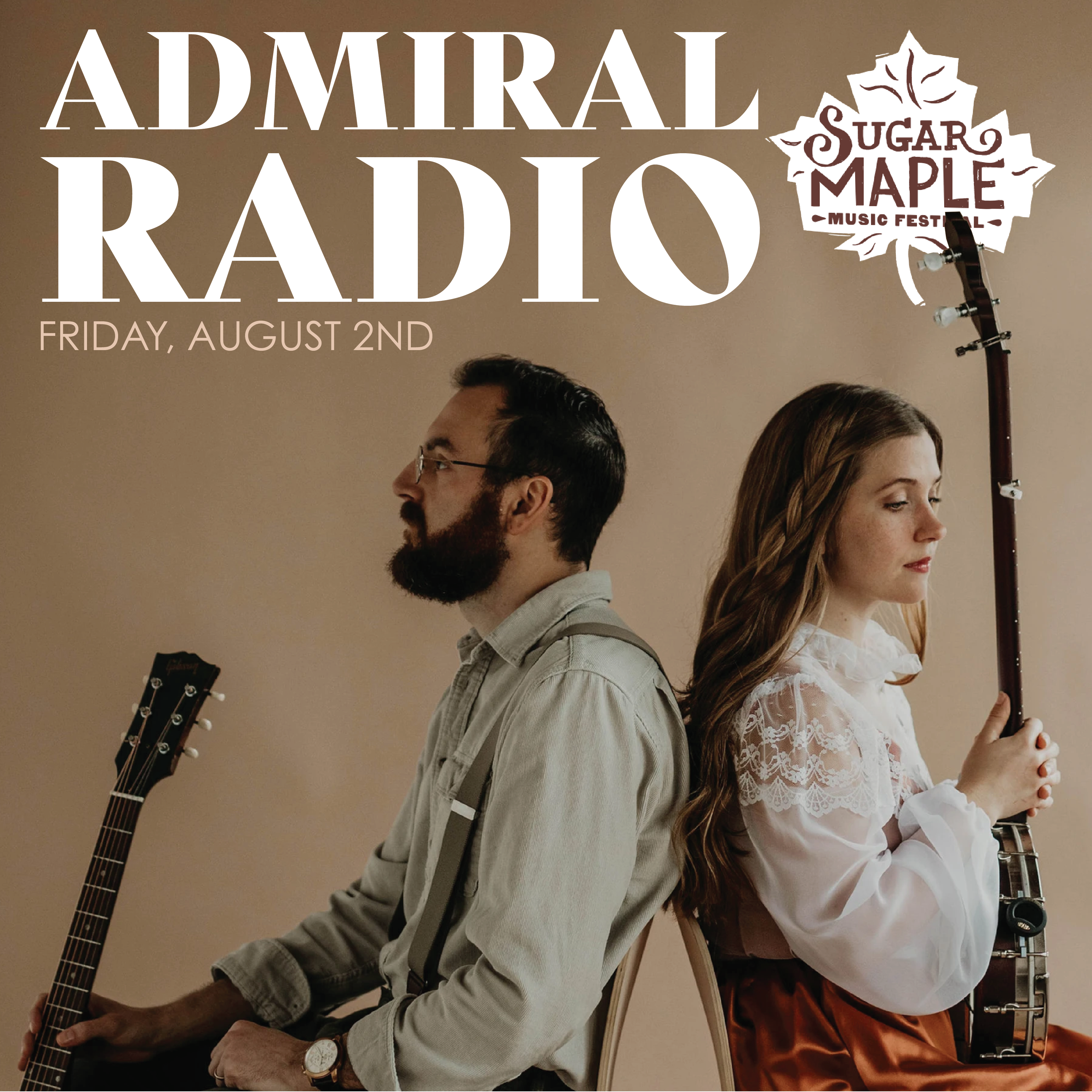
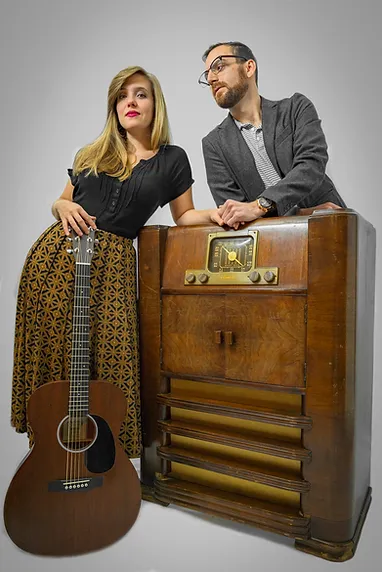
An acoustic wonderland, the duo Admiral Radio – husband-and-wife Coty Hoover
and Becca Smith of Columbia, S.C. – is one of the newcomers likely to emerge from the
crowded, phenomenal Americana field. Covid threw the group’s first launch for a loop,
but lost time made them more formidable for their second try.
With considerable songwriting chops and heavenly harmonies, Hoover, 32, and
Smith, 30, will make their first Midwest tour swing this summer, including two sets at the
Sugar Maple Music Festival: 5 p.m. Friday, August 1 in Madison’s Lake Farm County
Park on the main stage and an encore set later that day on the intimate Roots &
Reasons stage from 8:40-9:15 p.m.
Countless gigs in the Carolinas have turned them into a must-hear unit.
Sugar Maple: You post some accolades online, but one from the Columbia,
S.C., newspaper reads, “These ears haven’t heard a duo so attuned to each since
first encountering The Civil Wars.” Wow.
Becca: “Those are big shoes to fill.”
Coty: “We are big fans of The Civil Wars. We were listening to their live album in
the car yesterday. Other people have said that: We remind them of The Civil Wars.
That’s a huge compliment.”
SM: You met working at a restaurant in 2014 while you were students at the
College of Charleston. What was the restaurant?
Coty: “A Mediterranean cantina in downtown Charleston.”
Becca: “I was a hostess and Coty was a waiter. We quickly realized that we both
played guitar. We stayed at that restaurant for a good time. Coty became a manager.”
SM: Were you solo musicians at the time?
Coty: Becca had her own music going on. For me, music was always sitting in
my room and playing guitar. I would go to her shows. Slowly, I learned her songs, so I
could play with her onstage then she showed me how to sing harmony. We didn’t put
our first song out together until February 2019.
SM: What were your influences Becca?
Becca: Early Jewel, Sheryl Crow. I learned to sing harmonies from listening to
the Beatles and taking John’s part or Paul’s part.”
SM: You finally formed as music duo in 2018.
Becca: “Yes, we were going by the name Becca & Coty. We needed to figure out
a band name.”
Coty: “We were about to put out our first single, ‘Two-Star Motel.’ We needed a
band name. We didn’t want Becca & Coty.”
Becca: “Coty called me, ‘What about Admiral Radio?’ It does create a story, and
it does get to what we do: History of folk mixed with modern times.”
Yet, Admiral Radio is definitely contemporary Americana.
Becca: “In a live set, we might throw in a public domain traditional folk tune.
Coty: “People will sing along to ‘Oh, My Darling Clementine’ or ‘You Are My
Sunshine.’”
SM: This is a tough part of your story – you had a debut album done,
decided to go full time into music and had lots of shows lineup up. Then Covid
hit. Ouch.
Coty: “Yes. We had an East Coast tour set. I finished grad school and we were
full-time musicians.”
Becca: “We were trying to fly the plane as it was being built, but we were still
excited.”
Coty: “So, we were hit pretty hard. We recorded our set at the Sumter Opera
House in South Carolina. No one was in the audience. We put it on YouTube.”
Becca: “It was still a bummer. It was anti-climactic. We were fighting the defeatist
feeling, ‘Should we just call it quits? What should we do?’ We put the album out (during
Covid) in fall 2020. Coty became a Spanish teacher, and I became a German teacher.
We made other plans to get by. We always wanted to continue. We slowly put ourselves
back out there. It’s been a crawl to where we were.”
SM: You’re there now, filling up dates on your tour and making lots of new
music.
Coty: “We’re in a great spot.”
Becca: “We’ve been so hungry to get back to it. The last year has been nose to
the grindstone.”
SM: You have four terrific new singles on Spotify and more material ready.
Does it build up to an album?
Coty: “We noticed that the name of the game now is to release your music as
singles because people don’t have a long attention span anymore. That’s how it is, I
guess. There’s an oversaturation of everything at our fingertips.”
Becca: “We’ll release an album (in September), the whole package. We might
not like the singles model, but we want to catch up.”
SM: Your most emotional single is “Love You Somehow,” the tale of an
elderly widower. Oh my, it’s powerful.
Coty: “It’s my grandparents’ story.”
Becca: “After shows, people will share their stories.”
SM: It’s a moving video, too. (See it at:
https://www.youtube.com/watch?v=eg6FDCt7QTU)
Coty: “We were watching (my grandfather) live on without my grandmother for
the first time in 50 years. He’s heartbroken every day. I came up with the song in one
sitting. I was sobbing and walked into the room where Becca was.”
Becca: “I asked, ‘What’s wrong? What’s wrong?’”
Coty: “I said, ‘I’m okay. It’s this song I just finished.’”
SM: How tough is it to be married and play music full time together?
Becca: “We met working together at the restaurant. … We take a lot of
inspiration from Shovels & Rope (husband-and-wife Michael Trent and Cary Ann
Hearst) so much. We’re inspired by what they’ve achieved as a married couple.”
SM: Songwriting competitions have been extremely good for you. Honors
have come from the Tucson Folk Fest to a prominent Texas contest to an
international bluegrass society.
Coty: “A year ago, we didn’t really have many accolades that helps you be
marketable for venues. (Contest winning) makes you more intriguing. We thought, ‘Let’s
put time and effort into contests and showcases and see what comes out of it.’”
Becca: “It’s let us get the car further down the road. It’s not just my mom telling
me we’re great. It’s nice to say, ‘We’re not crazy.’ When you go down this road, you’re
like, ‘Are we cut out for this?’ It gets some wind in your sails.”
By Tom Alesia
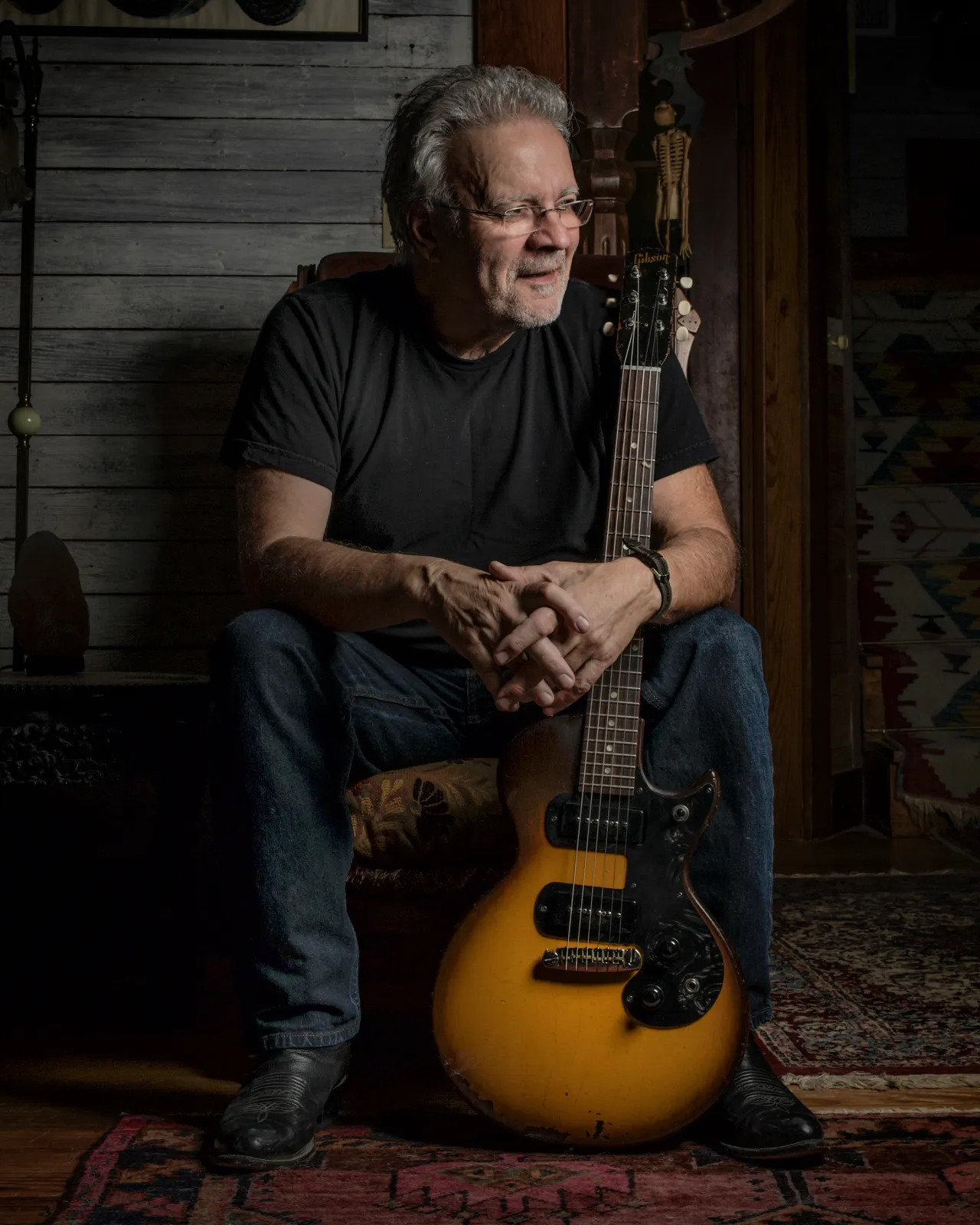
Canadian-American singer/songwriter Ray Bonneville
A one-man band, Ray Bonneville plays delicious bluesy Americana with guitar
and harmonica. He’s not in any rush, but his well-deep voice punctuates a sound that
emphasizes New Orleans influences. But Bonneville, at 75, isn’t taking it easy, releasing his 10th album, “On the Blind Side,” in 2023 – and he’s working on the next one. His debut album didn’t happen until he was in his 40s, but he developed a loyal following (which increased with streaming services) and became a critics’ favorite.
Bonneville returns to the Sugar Maple Music Festival for a late-afternoon set under the big tent on Saturday, August 3 at Lake Farm Park in Madison. He’ll also be at the Roots & Reasons side stage area at 6:40 p.m. See SugarMapleFest.org for ticket information and the full schedule.
In this interview, the Canadian-American singer/songwriter explored his extraordinary life.
Sugar Maple: You were 12 years old from Quebec and spoke only French, then
your big family moved to Boston. You went to an American school without
knowing English?
Bonneville: “Yes. I went into the eighth grade with no English. I only had the summer to
learn English from my neighbors.”
SM: How tough was it?
Bonneville: “It was challenging. Back then, I was kind of fearless. I just went with it.
What was unfortunate about it was they took my language barrier as some sort of
reason to put me in with some real unmotivated slow kids and left me there. That’s why I
got into trouble – and picked up the guitar. So, in a way, I’m grateful for it.”
SM: Who gave you the guitar?
Bonneville: “My mother. She didn’t play, but she saw my ear glued to the grill of the
radio when there was guitar music.”
SM: What did you think about having a guitar?
Bonneville: “I was thrilled about it. I just loved it. I took only one lesson, but I had a
chord book and I learned the first chords that were on the top of page one, book one.
Those are the chords I still play today.”
SM: Did you perform?
Bonneville: “I had a band in high school from 15 to 17. We played all the fraternity
houses in New England. We had a 1957 Cadillac ambulance to get around. We played
Ricky Nelson, Elvis Presley, Roy Orbison, the Kinks, Rolling Stones. All that stuff.””
SM: Then you signed up for the military at a young age during Vietnam.
Bonneville: “I was in the Marine Corps. They sent me to bootcamp when I was 17.
Basically, I was trying to get away from my father, who was a very authoritarian,
religious oppressor.”
SM: Is there any way to summarize your Vietnam experience?
Bonneville: “I was stationed in a combat zone in a place called Dong Ha, which was
close to the DMZ. I wasn’t off in the jungle, but I was subject to incoming fire a few times
each day – and never knowing where something would land. It took out a fair number of
personnel.”
SM: Was it difficult to overcome when you returned?
Bonneville: “It bothered me quite a bit.”
SM: Could you ever play music in Vietnam?
Bonneville: “In Vietnam, you could buy these very cheap plastic guitars from the same
people who could get you heroin. The plastic guitars would melt in a few weeks and
you’d buy another one. When I got out of Vietnam, I started playing again. I took up the
harmonica.”
SM: You then spent 20 years as a studio musician and live performer before
recording your own music. You did other jobs, too. One of the things that jumped
out from that period is the description that you played “rowdy rooms with blues
bands.” How rowdy?
Bonneville: “Really rowdy.”
SM: How?
Bonneville: “Always drunken. We played in a place in Colorado where there was no
law. Guys would shoot off guns. After 1978, I played in bands in the Rocky Mountains,
Texas, New Mexico, Wyoming and Montana. After that, I struck out on my own and
played in Alaska, New Orleans, Seattle, Boston and Paris.
SM: Still, some rowdy rooms. You meant it.
Bonneville: “At one point, I played five weeks straight, every night for four sets at the
Pipeline Club in Valdez, Alaska. That was one of the rowdiest places I’ve ever been.
There was a fight during each set. If they weren’t close to you, you kept playing.”
SM: Then you became a small plane pilot?
“In Boston, I flew planes that had advertising banners on the back. Then I flew sea
planes and that led to flying in the bush in Quebec, which I did for two years. But I was
always playing music.”
SM: Was it a tough job to be a bush pilot?
Bonneville: “You’re flying close to the ground and flying in bad weather. The reason I
started writing songs in my early 40s was that I scared myself so badly while flying in
some awful weather during the moose hunting season in Quebec.
That’s when I went to Boston to get an apartment and write songs. I wasn’t writing
before that. I was doing other people’s material my own way; I never tried to copy the
way they did it on the record. I took it and had my way with it. I developed my style.
Those 20 years, I consider to be school as a musician.”
SM: Did anyone say, “Mid-40s is too old to start as a solo artist”?
Bonneville: “No. And if they did, I would have ignored them.”
SM: Was it tough to write?
Bonneville: “I had to develop the nuance of the English language. I had learned to
speak it, but I read a couple of thousand books to immerse myself in the language and
become poetic with it. You only learn how to write by writing.”
SM: What’s it like touring now?
Bonneville: “I’m playing better rooms now. I’m slowing down on touring. I’m not doing
120 to 150 dates per year, which I used to do. Now I’m doing 50 dates a year. I still
enjoy the time on stage.”
SM: Are they good memories of paying your dues?
Bonneville: “Some memories were good. Others were, ‘What was I doing there?’ I’ve
played to no one, except the bartender. I played to two women in bowling shirts. I
played with a hockey game on the screen behind me. I’ve played every situation there
is.”
SM: Where do you live now?
Bonneville: “Off the north shore of Lake Superior, from May to October, in Canada. In
the winter, I’m in Austin, Texas.”
SM: In 2000, you won a Juno Award (the equivalent of Canada’s Grammy Awards)
for best blues album. The other Juno winners that year were Alanis Morissette,
Bryan Adams, Shania Twain and Sarah McLachlan. Wow.
Bonneville: “Those artists are good, but it’s just not what I listened to. I was more down
in the roots.”
SM: In 2021, you played part of a set here at the Sugar Maple Music Festival then
there was a torrential rain storm.
Bonneville: “Mary Battiata was after me and, during the storm, (Cajun musician) Joel
Savoy suggested we go to the back of the tent and play an impromptu acoustic jam.
That’s fun when you’re thrown a curve ball.”
SM: Do you still look forward to playing at 75?
Bonneville: “I love my time on stage! I’m still thrilled to play my songs. I’m so happy
that I play a setlist of my own songs.”
Check out this video for a sneek peek of the amazing performance coming up at Sugar Maple Saturday, August 3rd!